

Definitely Not Me
There is a unique kind of mid-flight panic that science has yet to fully classify, and I experienced the absolute peak of it somewhere over the Rocky Mountains on a packed flight from Chicago to Denver.
It was about two hours into the flight. I was crammed into 22B—the dreaded middle seat—sandwiched between a guy who looked like a competitive powerlifter on my left, and a very prim, impeccably dressed woman reading a hardcover biography on my right.
Now, I had made a critical, life-altering mistake at the airport terminal during our two-hour layover. I had consumed a massive bowl of spicy black-bean chili paired with a large draft beer. At sea level, my digestive tract is a finely tuned machine. At 35,000 feet, cabin pressure does things to the human body that violate the Geneva Convention.
About midway through the flight, my stomach let out a low, ominous rumble that felt like a tectonic shift.
I immediately went into lockdown mode.
I crossed my legs.
I clenched every muscle in my lower body.
I tried to distract myself by scrolling through the in-flight movie selection, but I knew I was living on borrowed time.
I kept praying for the "Fasten Seatbelt" sign to turn off so I could make a frantic break for the lavatory, but we were hitting light turbulence and the captain was keeping everyone locked down.
Then came the moment of betrayal.
I sneezed.
The sudden, violent contraction of my diaphragm overrode my defenses. It wasn't a loud noise—thankfully, the engine hum masked the acoustics—but it was a slip. A silent, heavy, catastrophic thermal event had been unleashed into the cabin air.
Within roughly four seconds, I knew I had created a monster. The sheer potency of what I had just done was staggering. It wasn't just an odor; it was an environmental hazard. It felt like it had its own weather system.
Panic, pure and primal, set in. I knew that if the people around me realized I was the source, I would have to legally change my name and move to a different continent. I needed a strategy, and I needed it immediately.
I went on the offensive.
I suddenly stopped looking at my screen, narrowed my eyes, and did a sharp, theatrical sniff. I flared my nostrils, looked disgusted, and immediately turned my head to the left to stare directly at the powerlifter.
I didn't just look at him; I gave him the "disappointed disappointed-father" look.
I pulled the collar of my shirt up over my nose, winced, and shifted my weight as far away from him as humanly possible, right into the personal space of the woman on my right.
The powerlifter, who had been peacefully dozing with a neck pillow, felt my intense, burning gaze. He opened his eyes, blinked groverly, and looked at me. I kept my shirt over my nose and gave a subtle, accusatory shake of my head.
"Dude," I whispered under my breath, just loud enough for him to hear over the engines.
He looked genuinely confused, then his nose caught the wave. His eyes went wide. But instead of taking the blame, he immediately looked across the aisle at a guy in row 21 who was peacefully eating a ham sandwich. The powerlifter pointed a massive finger toward the sandwich guy and mouthed, “Not me."
Meanwhile, the classy woman to my right finally hit the wall of aroma. She let out a sharp, audible gasp, slammed her hardcover biography shut, and aggressively reached up to twist her overhead air vent to maximum blast, aiming the nozzle directly at the space between her and me.
Seeing an opportunity to solidify my innocence, I quickly reached up and did the exact same thing, aiming my air vent directly at the powerlifter like I was trying to blow the toxic cloud back to his side of the aircraft.
"Some people have no respect for public spaces," I muttered loudly to the woman, shaking my head in absolute disgust.
She looked at me, her eyes watering slightly from the air current and the fumes, and nodded in frantic agreement.
"It’s completely unacceptable," she whispered back, glaring daggers at the back of the head of the guy eating the ham sandwich in front of us, who was entirely oblivious to the fact that he was currently the prime suspect in an aviation crime.
For the remaining forty minutes of the flight, the entire radius of rows 21 through 24 descended into a silent state of psychological warfare. Everyone was sniffing the air, glaring at everyone else, and adjusting their ventilation nozzles like anti-aircraft guns.
I sat right in the eye of the storm, looking the most offended of all, occasionally letting out heavy, dramatic sighs of suffering.
When the plane finally touched down and the doors opened, I scrambled out of that middle seat, grabbed my carry-on, and practically sprinted down the jetway. I have never felt a greater combination of intense shame and absolute, criminal triumph in my entire life.

The Shoes My Father Never Bought
When I was ten years old, I thought my father was the cheapest man in the world.
Every year, right before school started, my friends would show up wearing the newest Nike shoes.
Some had Jordans.
Some had Reeboks.
Some even had the shoes with the lights in the heels that flashed every time they walked.
I wanted them more than anything.
Every Saturday, my father and I would walk through the mall, and I'd stop in front of the display window.
"Dad... can we get those?"
He'd look at the price tag.
Then he'd smile.
"Those are nice."
"We'll see."
"We'll see" always meant no.
Instead, we'd drive to a discount store on the other side of town.
He'd buy me a pair of plain white sneakers.
Every year.
I hated them.
The first day of fifth grade, one of the boys looked down at my shoes and laughed.
"My grandpa has those."
The whole class laughed.
That afternoon I came home furious.
"You never buy me anything nice!"
I remember throwing my backpack across the living room.
"You just don't want to spend money!"
My father didn't yell.
He didn't get angry.
He simply picked up my backpack, placed it by the front door, and quietly said,
"I'm sorry you feel that way."
At the time, I thought it was the weakest answer he could have given.
I didn't speak to him for two days.
Looking back now...
I'd give anything to take those two days back.
Life moved on.
I grew up.
Went to college.
Started working.
Eventually I got married and had children of my own.
My father got older.
His hair turned gray.
His hands became rougher.
He retired after nearly forty years working maintenance at a manufacturing plant.
One afternoon, a few months after my mother passed away, I was helping him clean out the garage.
In the corner sat an old metal toolbox I'd never seen before.
Inside were hundreds of neatly folded envelopes.
Every envelope had a year written on it.
1989.
1990.
1991.
1992.
Curious, I opened one.
Inside were receipts.
Electric bills.
Mortgage payments.
Medical bills.
School tuition.
Every dollar my parents had spent.
Then I noticed something strange.
Each envelope had one handwritten note.
"Didn't buy new work boots this year."
Another.
"Patched the old ones again."
Another.
"Brake repair can wait another month."
Then I opened the envelope from the year I was in fifth grade.
There was a receipt from the shoe store.
The exact Nike shoes I'd begged for.
Except they hadn't been purchased.
Written beside the receipt, in my father's handwriting, were seven words.
"Couldn't afford two pairs this year."
I stared at the paper for a long time.
Then I looked down.
At the very bottom of the envelope was another receipt.
A pair of heavy-duty steel-toe work boots.
Next to it...
"Repaired old boots instead."
I suddenly realized something.
My father hadn't refused to buy me expensive shoes because he didn't want me to have them.
He refused because he had already decided that if someone in the family was going to wear worn-out shoes...
It would be him.
Not me.
I sat on the garage floor and cried harder than I had since my mother's funeral.
A few minutes later, my father walked in carrying two glasses of lemonade.
He saw the envelopes.
He immediately knew.
For a moment neither of us spoke.
Then I asked him the question I'd carried since childhood.
"Why didn't you ever tell me?"
He smiled the same quiet smile he'd worn my entire life.
"Because that's not how love works."
I looked at him.
He continued.
"If I had told you..."
"...it would've felt like I wanted credit."
He shrugged.
"You were my son."
"It wasn't a sacrifice."
"It was just my job."
Today, I'm forty-four years old.
I have a twelve-year-old son who recently asked me for a pair of expensive basketball shoes.
I bought them.
Not because I wanted to spoil him.
Because I finally could.
A few weeks later, he looked down at my old sneakers and asked,
"Dad... why don't you ever buy yourself new shoes?"
I laughed.
For a second...
I saw my father.
And without even thinking, I gave him the exact same answer.
"We'll see."
Last month, I bought my father the nicest pair of work boots I'd ever seen.
He laughed when he opened the box.
"I'm retired," he said.
"I don't need these anymore."
"I know," I answered.
"But I do."
He looked confused.
"So every time I visit..."
"I can finally see you wearing the pair you always deserved."
He didn't say anything.
He just hugged me.
It was the first time in my entire life I'd ever seen my father cry.
People spend their childhood believing love looks like buying someone everything they ask for.
Age teaches you something different.
Sometimes love looks like quietly going without...
...so your child never has to.

The Bowl I Couldn't Break
I still remember the exact moment I realized I wasn't in love anymore; I was just terrified.
It didn't start with screaming or broken dishes. If it had, I would have walked away on week two. When I first met Marcus in 2024, he was the most attentive, charming guy I had ever known. He used to leave little notes on my car windshield before work. He wanted to know everything about me. I thought it was romance. Looking back, it was data collection.
The shift happened so slowly that I didn't even notice the walls closing in until the door was locked. First, it was the comments about my friends. "Sarah doesn't really respect your time, you know?" or "Your brother always seems to look down on me." He said it with so much concern for my well-being that I believed him. Slowly, I stopped texting them. It was just easier than dealing with his quiet, freezing moods afterward.
Then came the financial control. He convinced me that we should save for a house together, so I let him handle our shared budget. Within six months, my paycheck went straight into an account I didn't have the login credentials for. If I wanted to buy a €4 coffee or a pack of makeup wipes, I had to text him for permission. If I didn't, he wouldn't yell. He would just do this terrifying thing where he completely ignored me for three days straight, staring right through me in our small apartment like I didn't exist. The silence was louder than any screaming match. It eroded my sanity until I was apologizing on my knees for things I hadn't even done, just to make him look at me again.
By mid-2025, I didn't recognize myself. I was twenty-six, but I felt eighty. I walked on eggshells in my own home, constantly calculating the exact pitch of my voice, the time I arrived home from work, and the clothes I wore to keep him from turning into a stranger.
The turning point was so small, but it saved my life.
It was a Tuesday night. I was chopping onions for dinner, and I accidentally dropped a ceramic bowl. It shattered on the kitchen tile. It was an accident. But the sound made me freeze. My heart started hammering against my ribs so hard I couldn't breathe. I scrambled to the floor, frantically trying to pick up the sharp shards before he walked through the front door, crying because I knew what the broken bowl would mean—another week of the silent treatment, another week of being told how clumsy, stupid, and useless I was.
As I sat there bleeding from a tiny cut on my thumb, looking at my reflection in the oven door, a sudden wave of clarity hit me like ice water. I wasn't crying because the bowl was broken. I was crying because I was living in a prison I had helped him build. I knew I couldn't just tell him I was leaving.
The one time I had brought up taking a break a few months prior, he had blocked the front door with his body, taken my phone, and told me that if I ever tried to leave him, he would make sure my family found out about things that would ruin them. I knew he was bluffing, but the sheer malice in his eyes told me everything I needed to know. I had to go, but I had to be smart.
It took me three months to plan it. Three months of playing the perfect, submissive girlfriend while quietly reclaiming my life in secret.
*The Secret Account: I went to a bank near my office during my lunch break and opened a completely private checking account. I told my HR department to split my paycheck, sending 90% to our shared account so Marcus wouldn't notice, and 10% to the secret one.
*The Code Word: I finally reached out to Sarah, the friend I had ignored for a year. I called her from a burner app on my laptop at work. I didn't tell her everything because I was too ashamed, but I told her enough. We agreed on a code word: "Pineapple." If I texted her that word, it meant she needed to show up at my apartment with her car trunk empty.
*The Essentials: I slowly began smuggling my life out of the apartment in my work bag. One day it was my birth certificate and passport. The next week, it was a few sentimental pieces of jewelry my grandmother gave me. I left them in a locker at my office.
The day came on a Thursday in October. Marcus was scheduled to be at an out-of-town corporate seminar until 8:00 PM.
My hands were shaking so badly I could barely type, but at 2:00 PM, I sent the text to Sarah: Pineapple.
Thirty minutes later, she pulled up to the curb. She didn't ask questions. She didn't lecture me about why I had stayed so long. She just hugged me, threw my two duffel bags into the back seat, and handed me a cup of hot tea.
Leaving that apartment was the heaviest and lightest feeling in the world. I left my keys on the kitchen counter next to a brief, one-sentence note: "Do not contact me, do not call my family, we are done."
I spent the next two weeks sleeping on Sarah’s living room couch, jumping every time the text notification on my phone went off. Marcus tried everything. He sent dozens of emails ranging from pathetic, weeping apologies to vague, dark threats. But this time, I didn't reply. I blocked his number, deleted my old social media accounts, and went straight to a local legal aid clinic to file for a protective order.
It’s been almost a year now. I have my own tiny, studio apartment. The furniture is mismatched, and the radiator makes a horrific clanking sound every morning, but every square inch of it belongs completely to me.
Sometimes I still catch myself apologizing to empty rooms when I drop something, or feeling a flash of panic when I spend money without asking.
Healing isn't a straight line, and the damage he did runs deep.
But the first time I sat on my floor, eating pizza out of the box at midnight in total, peaceful silence, I realized something incredible: I am not broken.
He tried to dim my light, but he didn't manage to put it out.
Really, Dude?
Back in 2005, I worked at a convenience store.
I also had a girlfriend whose family had serious money.
Her father was a very successful attorney. They lived in this enormous house that was probably worth around five million dollars, which in 2005 seemed like an unbelievable amount of money. They had expensive cars, a beautiful home, all of it.
And then there was me.
Working behind the register at a convenience store.
My girlfriend never made me feel bad about it. She actually came to the store all the time just to hang out with me while I worked.
But apparently, somewhere inside my young male brain, I had decided that because her family had money, I needed to look like I had money too.
One day I found a website selling fake Rolexes.
Not just fake Rolexes.
According to the website, these were apparently such incredible replicas that "nobody could tell the difference."
I believed them. The watch was $300.
Now, $300 wasn't exactly pocket change for someone working at a convenience store, but I convinced myself this was an investment in looking successful.
I ordered it.
When that thing arrived, you would've thought Rolex had personally delivered it from Switzerland.
I wore it everywhere. And I didn't wear it quietly either.
I wore that watch with the confidence of a man who had just walked into a jewelry store, written a check for $25,000 and told the salesman to keep the change.
I would casually rest my wrist on things.
The counter.
The steering wheel.
Anywhere the light might catch it.
Nobody had asked about my watch. That didn't matter. I knew it was there.
Then one day my girlfriend was hanging out with me behind the register.
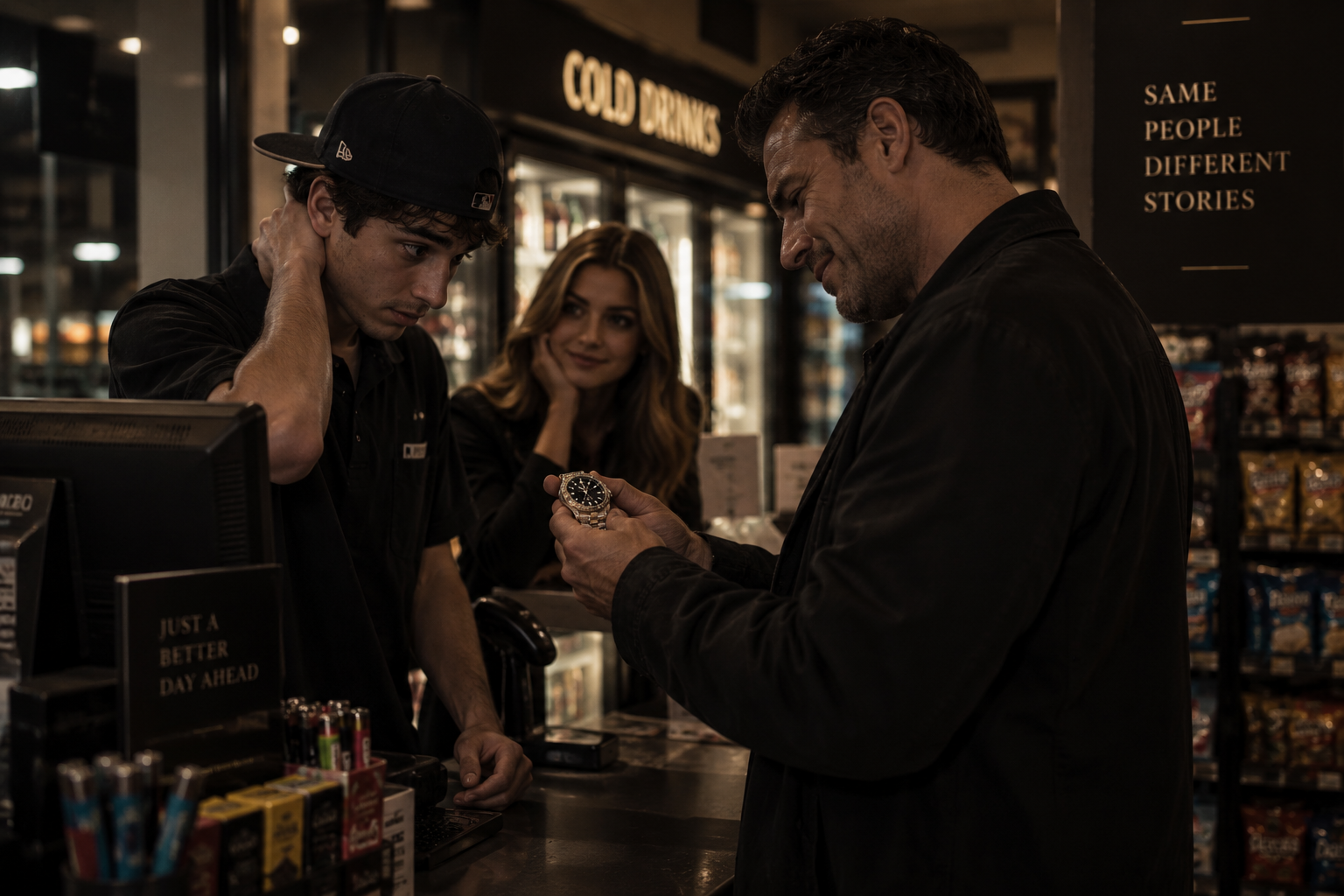
A regular customer came in. He knew me pretty well. We're talking, and suddenly he notices my wrist.
"Nice watch, dude."
Finally.
The moment I'd been waiting for.
I looked down at it like I'd almost forgotten I was wearing a Rolex.
"Thanks."
Then he said something I wasn't prepared for.
"Let me see it."
No problem.
Remember, the website had specifically told me nobody could tell it was fake.
And obviously, websites selling counterfeit watches were known for their honesty.
I took it off and proudly handed it to him. He looked at it. Turned it over. Looked at it again.
Then he looked directly at me. There was a pause.
"REALLY, DUDE?"
My heart dropped.
He knew.
Immediately.
This indestructible $300 masterpiece of Swiss deception had survived approximately four seconds of inspection.
And my rich girlfriend was standing a few feet away.
Luckily, she was distracted.
I looked at him and began communicating in a form of sign language that does not exist in any recognized language on Earth.
My eyes were saying:
"PLEASE."
My head was saying:
"DO NOT DO THIS TO ME."
My hands were probably saying:
"I WILL GIVE YOU FREE SNACKS FOR THE REST OF YOUR LIFE."
He looked at me.
Then he looked toward my girlfriend.
He understood.
A little smile appeared on his face.
He handed the watch back.
"Nice watch."
And walked away.
I wanted to crawl underneath the register.
That night, I was lying in bed thinking about what happened, and eventually I started laughing.
I had spent $300 trying to convince people I had enough money to spend thousands. And the funniest part was that my girlfriend had never asked me to do that.
She already knew where I worked.
She knew I wasn't rich.
She came and sat at a convenience store just because she wanted to spend time with me.
I was the only person I was trying to impress.
That stupid watch actually taught me something.
I decided that night that I never wanted to pretend to have something I hadn't earned.
If one day I wanted the real watch, I'd work for it. If I couldn't afford it, I wouldn't wear it.
I'd rather have something inexpensive that was mine than something expensive that required me to pretend.
I don't know what happened to that fake Rolex.
But more than twenty years later, I still remember the exact look on that guy's face when he turned it over.
No jeweler.
No magnifying glass.
No sophisticated authentication.
Just four seconds.
A look directly into my eyes.
And two words that destroyed my entire career as a fake millionaire:
"Really, dude?"
The Man Who Paid For My Groceries
The most valuable thing a stranger ever gave me cost less than a hundred dollars.
Three years ago, my life quietly unraveled. Within five months, I lost my job, my relationship ended, and I burned through almost all of my savings trying to convince myself I'd find work before the money ran out.
I didn't. I applied everywhere. Sales. Customer service. Warehouses. Retail. Office jobs. Anything.
Most companies never responded. The few interviews I did get always ended the same way. "We'll keep your résumé on file."
Eventually, I signed up to drive for Uber Eats and DoorDash just to keep the lights on. My car wasn't anything special—a 2011 Honda Accord with almost 180,000 miles on it—but it ran, and at that point, that's all that mattered.
Some weeks I made enough to pay my bills. Most weeks I didn't. I became obsessed with numbers.
Every tank of gas. Every grocery receipt. Every dollar mattered.
One Tuesday afternoon, after finishing a lunch rush, I stopped at the grocery store on my way home. Before I walked inside, I opened my banking app.
Available balance: $61.84 That wasn't all the money I had. That was all the money I had. Rent was due in four days.
I walked through the store doing math in my head. Bread. Eggs. Milk. Chicken. Rice. Frozen vegetables.
Nothing went into my cart unless I absolutely needed it. I even picked up a box of cereal before putting it back. It wasn't necessary.
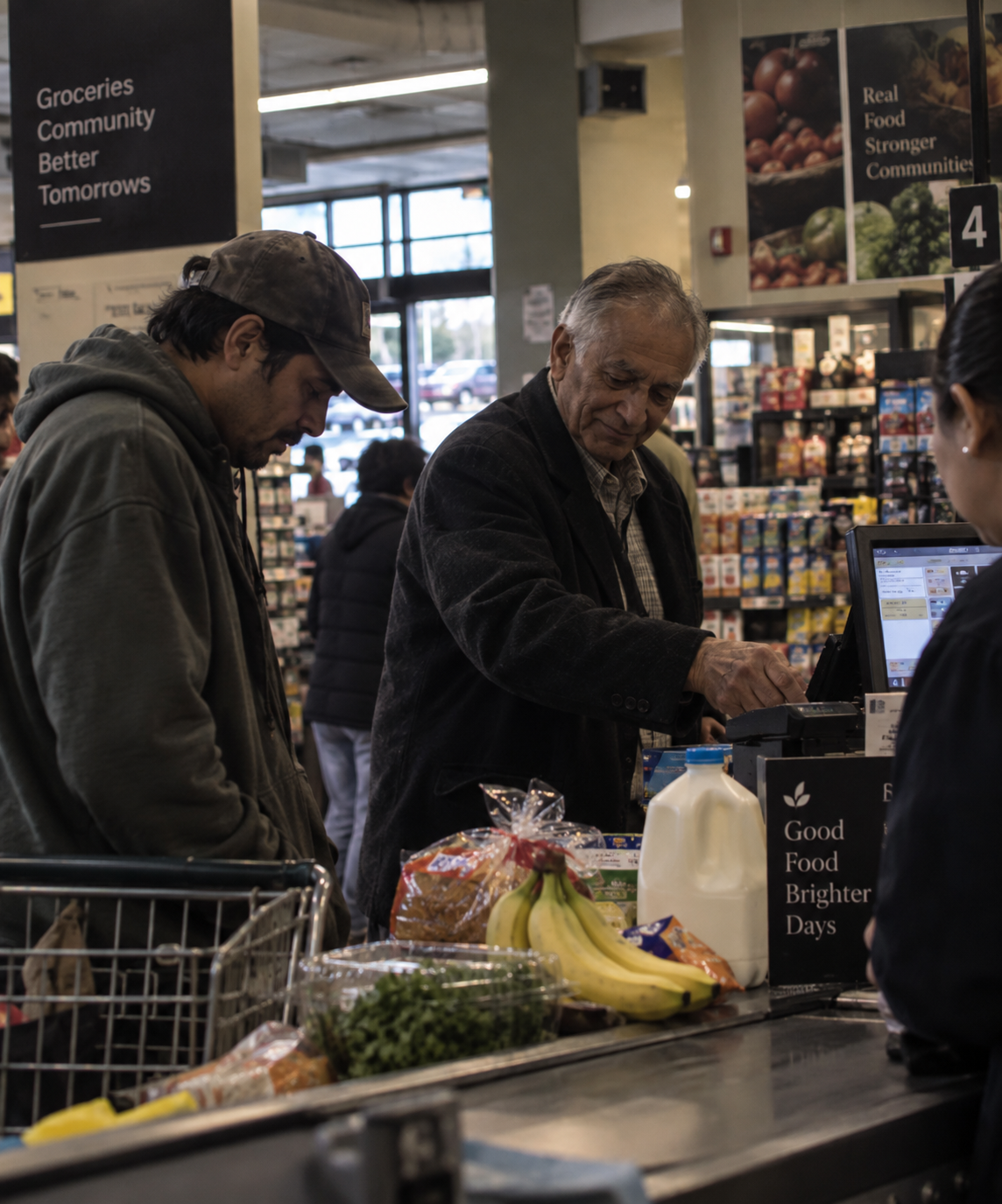
At the checkout, the cashier scanned everything. Total: $68.27 I stared at the screen. I was short. Not by much. But enough. Trying to hide my embarrassment, I asked her to remove the chicken. Then the cereal I'd decided to grab at the last second. Then the coffee.
The people behind me were waiting patiently, but I still felt like every second took an hour.
The cashier looked at me and asked softly, "Is this okay now?" Before I could answer, I heard a calm voice behind me. "I'll take care of it."
I turned around. An older man, probably in his seventies, stepped forward and handed the cashier his credit card.
"No, sir," I said immediately. "I appreciate it, but I can't let you do that."
He smiled. "You can." "I really can't."
He looked at me for a moment before saying something I'll never forget.
"You don't get to decide when someone else gets to be kind."
I didn't know what to say. The cashier finished the transaction, handed me my receipt, and wished me a good day.
As I walked toward the parking lot, I noticed the man loading groceries into his car a few spaces away. I walked over. "I don't even know how to thank you." He leaned against his trunk and shrugged. "When I was thirty, I lost everything." I waited for him to continue. "My business failed. We lost our house. For a while, I honestly believed my kids would remember me as the father who couldn't provide." He smiled to himself.
"One afternoon, someone paid for my groceries." I laughed quietly. "So this is your way of paying them back?" He shook his head. "No." He looked me straight in the eyes. "I'm paying you back." I must have looked confused because he smiled again. "One day, you'll understand."
Before getting into his car, he reached into the grocery bag he'd just bought. He pulled out a package of ground coffee. "I noticed you put this back." He handed it to me. "Everyone deserves one small comfort." Then he drove away.
That night, I made myself a cup of coffee. It wasn't the best coffee I'd ever had. But it was the first cup I'd enjoyed in months.
Six months later, I found a full-time job. A year after that, life finally felt stable again. Last winter, I was standing in line at the same grocery store when the young father in front of me quietly asked the cashier to remove baby formula because he didn't have enough money.
Without thinking, I reached for my wallet. "I've got it."
As I walked back to my car, I finally understood what the old man meant.
He hadn't bought me groceries. He hadn't bought me coffee. He had restored something I'd started to lose.
My belief that people still looked out for one another.
Sometimes the greatest gift a stranger can give you isn't money.
It's the reminder that even on your worst day, you're not invisible.
I Don't Believe My Own Promises Anymore
I’ve cheated in every serious relationship I’ve ever been in.
There isn’t a nicer way to say it. I could tell you that some relationships were already falling apart, that I was young the first few times, that alcohol was involved sometimes, or that I wasn’t getting what I needed at home. I’ve used every one of those excuses before.
The truth is much simpler.
I cheated because I wanted to.
And then I did it again.
I’m thirty-six now. I’ve had four relationships that I would consider serious, including the one I’m in now. Every one of those women has eventually discovered some version of the same person hiding behind the man they thought they knew.
Sometimes it was messages. Sometimes it was someone I met while traveling for work. Sometimes it was a woman I already knew and had been telling my girlfriend was “just a friend.”
I became very good at separating things in my head. I could spend Saturday afternoon with my girlfriend, cook dinner with her, lie in bed watching a movie, tell her I loved her, and somehow put what I had done two nights earlier into a completely different compartment.
That’s probably the part I’m most ashamed to admit.
Because I did love some of them.
I know people will read that and say you don’t cheat on someone you love. Maybe they’re right. I don’t know anymore. All I know is that I felt love for them. I missed them when they were gone. I worried when they were sick. I remembered their birthdays. I knew how they took their coffee and what made them laugh.
And I still cheated.
Every time I got caught, I became the person I should have been before I did it.
I cried. I apologized. I handed over my phone. I deleted numbers. I unfollowed women. I promised there would never be another secret conversation, another hotel room, another lie about where I had been.
And in those moments, I meant it.
That’s what makes this difficult to explain.
I wasn't standing there thinking, I'll tell her whatever she needs to hear and then do it again.
I genuinely believed I was going to change.
For a while, I usually did.
Three months. Six months. Once, almost a year.
Then somebody would flirt with me. Or I’d be traveling alone. Or I’d download an app just to “look.” I’d tell myself that messaging wasn't cheating. Then I'd meet someone for a drink and tell myself a drink wasn't cheating.
Eventually, I'd cross the same line again.
I've wondered whether I'm addicted to sex. I don't know if that's actually what this is. Maybe I'm addicted to being wanted. Maybe it's the secrecy. Maybe I need the validation. Maybe I'm just selfish and have spent years trying to find a diagnosis that sounds better than that.
Friends have told me to go to therapy.
I don't believe in it.
Maybe that's stubborn. I've always had this idea that I'd sit in an office once a week, pay someone hundreds of dollars to ask me how things make me feel, and walk out exactly the same person. I keep thinking I should be able to fix this myself.
Except I've been saying that for years.
My current girlfriend caught me eight months ago.
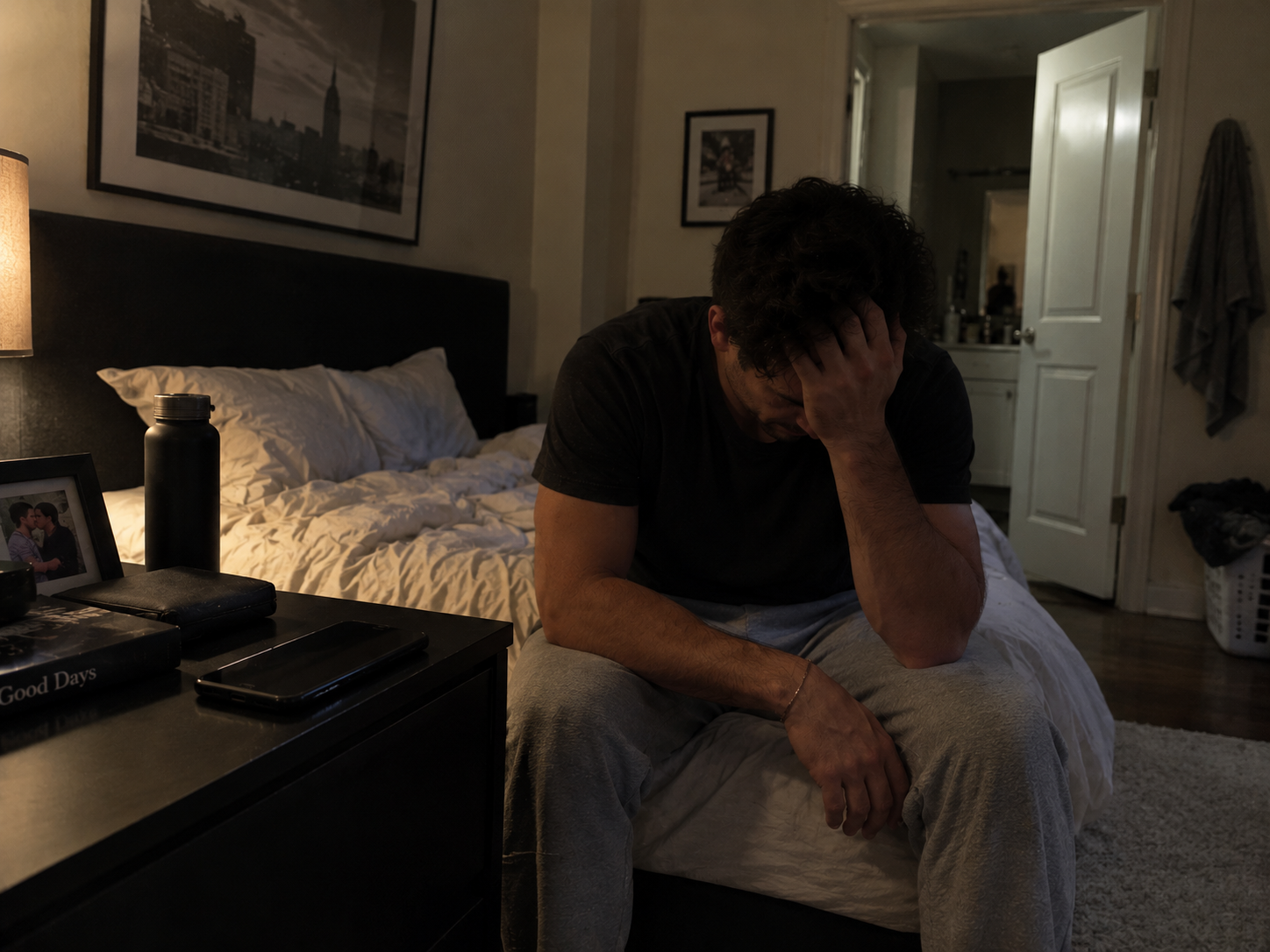
She found messages on my phone while I was showering. I remember walking into the bedroom and seeing her sitting on the edge of the bed holding my phone.
She didn't scream.
She just asked, “How many times?”
I lied.
I said once.
She asked again.
I admitted there had been more.
Then she asked me something none of my exes had ever asked.
“Do you actually think you're going to stop?”
I immediately said yes.
She looked at me for a long time and said, “That's not what I asked.”
I still think about that.
She stayed.
I promised her everything I've promised before. I gave her my passwords. I stopped going out without her for a while. I told her she could check my phone whenever she wanted.
And I haven't cheated on her again.
Yet.
I hate that I added that word.
Because that's the confession.
I want to tell you I've finally learned my lesson. I want this story to end with me saying losing people I loved scared me straight and I'm a different man now.
But I don't know if that's true.
The thoughts are still there.
I still notice opportunities. I still feel that rush when someone new shows interest in me. Sometimes I catch myself beginning the same little negotiations in my head that have always come before the cheating.
It's only flirting.
I'm not going to actually do anything.
She'll never know.
And that's when I realize how little I trust myself.
So this isn't really an apology where I'm asking anyone to forgive me.
Especially my ex-girlfriends.
Some of you gave me another chance after I swore there would never be another woman. Some of you blamed yourselves. One of you asked me what the other woman had that you didn't.
I told you that you hadn't done anything wrong.
That might have been the most truthful thing I said.
You weren't missing anything.
I was.
And to the woman I'm with now, I'm sorry because you've already heard every promise I know how to make.
You deserve certainty from me, and I don't know how to give you that.
I don't want to keep living like this. I don't want another woman sitting on the edge of a bed holding my phone. I don't want to keep hurting people and then becoming devastated when they finally stop believing me.
But I'm also tired of saying, I'll never do it again, as though saying it strongly enough will somehow make it true.
Maybe the thing I need to admit isn't that I can't change.
It's that whatever I've been doing to change clearly hasn't worked.
And after all these years, I'm finally scared that one day I'm going to meet someone I truly cannot imagine losing.
And I'm going to lose her anyway.
It Was Only Eighteen Dollars
I never thought eighteen dollars could make a grown man cry.
At the time, I was thirty-eight years old, married, with two young daughters who believed their dad could fix anything. To them, I was the strongest person in the world. To my wife, I tried to be. But behind closed doors, I was slowly falling apart.
Three months earlier, the company I'd worked for since I was twenty-three closed its doors without warning. One Friday afternoon we were told to pack our desks. By Monday morning, the building was empty. I walked out carrying a cardboard box and a smile I didn't feel because I couldn't bear the thought of calling my wife and telling her that our entire life had just changed.
For the first few weeks I convinced myself I'd find another job quickly. I updated my résumé, sent out applications, and went to interviews that always ended the same way. "We'll let you know." They never did.
Our savings disappeared faster than I ever imagined possible. The mortgage didn't care that I was unemployed. Neither did the electricity company. Or the insurance company. Or the credit card bills that kept arriving every month like little reminders of my failure. I stopped sleeping.
Every morning I woke up before everyone else and sat at the kitchen table with a calculator, trying to perform financial miracles that simply didn't exist.
One afternoon my oldest daughter came running into the room holding a permission slip.
"Dad! Everyone's going on the school field trip!" She was so excited. "It's only eighteen dollars."
Only.
I smiled.
"Of course, sweetheart." She hugged me and ran back upstairs. The moment she disappeared, I opened our checking account. The balance was $14.63. I checked it three more times, hoping I'd somehow missed a digit. I hadn't.
For the first time in my life, I realized I couldn't afford eighteen dollars. I sat there staring at the screen for almost an hour. I wasn't thinking about the money anymore. I was thinking about what kind of father couldn't send his daughter on a school trip because he was three dollars and thirty-seven cents short.
That night I barely spoke during dinner. My wife noticed. She always noticed. After the girls went to bed, she quietly slid an envelope across the table.
Inside was cash. More cash than I'd seen in weeks.
"Where did this come from?" I asked. She looked down at her hands before answering. "I sold my wedding ring." I laughed because I genuinely thought she was joking.
She wasn't. She had gone to a jeweler that afternoon while I was out dropping off résumés.
"I'll buy you another one," I said. She reached across the table, held my hand, and smiled.
"I didn't marry the ring."
That sentence broke something inside me. Not because she sold it. Because she had done it without making me feel like I'd failed. The next morning I paid the eighteen dollars. My daughter came home that afternoon talking nonstop about feeding goats, riding the bus with her best friend, and how it was "the best day ever."
She had no idea what it had cost us. Six months later, I finally found another job. It didn't pay as much, but it was enough. A year after that, I took my wife back to the same jewelry store. I asked the owner if he remembered buying her ring.
He nodded.
"I'd like to buy it back." He smiled and disappeared into the back room. A few minutes later he returned holding a small velvet box. He had kept it.
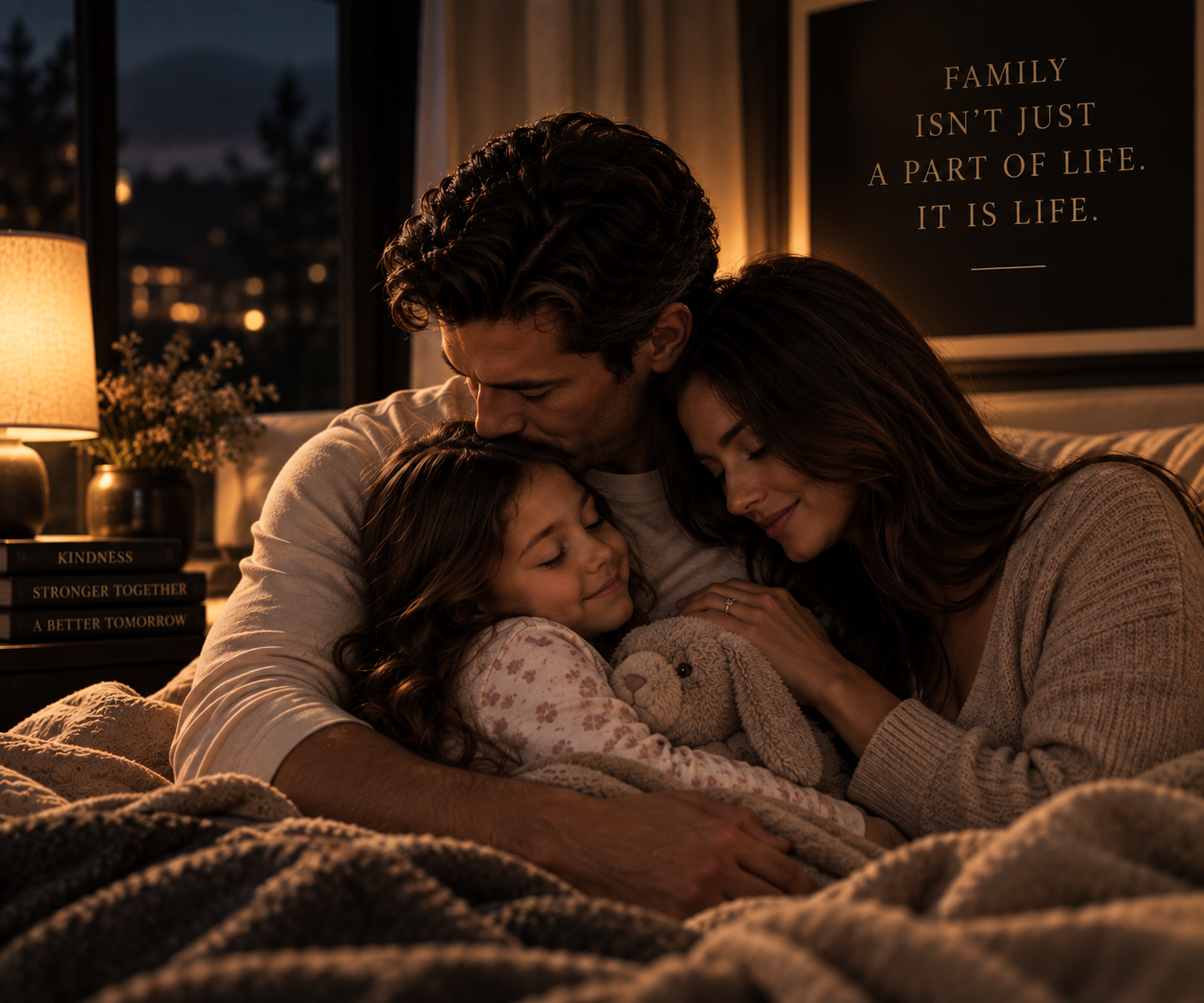
I proposed to her all over again in our living room while our daughters laughed because they thought their parents were being silly. She still wears that ring today.
But whenever someone compliments it, I don't think about diamonds. I think about sacrifice. I think about love. I think about the day my wife quietly carried a burden that she never should have had to carry alone.
Losing my job wasn't the hardest part of that year. The hardest part was believing that my worth as a husband and a father was measured by the balance in my bank account.
It isn't.
If you're reading this while worrying about money, I hope you remember something I wish someone had told me years ago:
Your family will remember how you loved them far longer than they'll remember how much money you made.
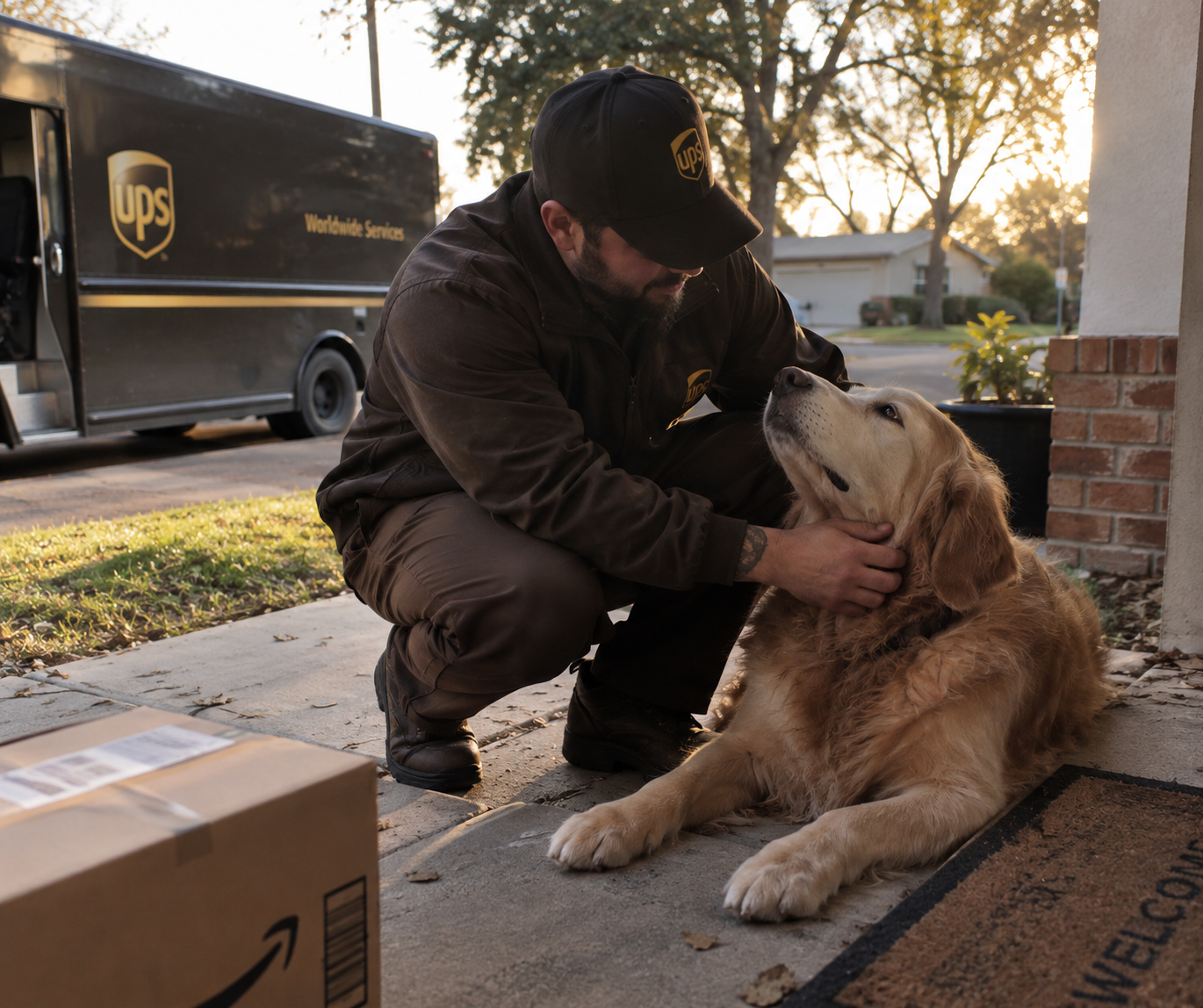
My Favorite Stop
I've been delivering packages for almost nine years, and after a while, you stop seeing addresses as houses.
They're just numbers.
You learn which streets have nowhere to park, which apartment buildings require a code nobody ever remembers to put in the delivery instructions, and which houses have dogs that sound like they're going to come through the front door.
In the summer of 2022, I was working a route in Sacramento, California. One of my regular stops was a small beige house on a quiet street not far from Arden-Arcade.
The address was 417.
I don't remember the first package I delivered there, but I remember the dog.
He was an old golden retriever named Charlie.
The first few times I came, Charlie would be lying near the front door. As soon as he heard the truck, he'd slowly get up and walk toward me.
And I mean slowly.
His face had gone almost completely white, his back legs weren't great, and he had that stiff walk older dogs get where every step looks like it requires a little planning.
But his tail worked perfectly.
The owner was a woman named Linda, probably in her late sixties. One afternoon she opened the door while I was scratching Charlie behind the ears.
"He waits for you now," she said.
I laughed. "He waits for the packages?"
"No. You."
I thought she was joking.
After that, I started noticing him before I noticed the house.
Some days he'd be lying in the shade near the porch. Other days I'd see his head through the front window. If Linda had the door open, Charlie would hear my truck before I even stopped.
Eventually I started keeping dog treats in the truck.
Technically, they weren't just for Charlie. There were plenty of dogs on my route. But somehow the bag always seemed to end up in my pocket before I got to 417.
I started talking to him too.
"What's up, old man?"
"Still here?"
"You guarding the place today?"
Normal stupid things you say to a dog when nobody is around.
For almost two years, Charlie was part of my route.
I knew almost nothing about Linda. We probably never talked for more than two or three minutes at a time. But I knew Charlie had been her husband's dog originally. Her husband had died several years earlier, and Charlie had been with her ever since.
"He got me through it," she told me once.
That was all she said.
I understood what she meant.
Toward the end of 2023, Charlie started having more trouble getting to the door. Sometimes he'd just lift his head when I came.
So instead of making him walk to me, I'd bring the package over and sit beside him for a minute.
I'd give him his treat, scratch his neck and go back to work.
I had over a hundred stops some days. Everything about the job is built around moving quickly.
But I always gave Charlie his minute.
Then one Tuesday in February, I pulled up to 417 and he wasn't there.
I didn't think much of it.
The next delivery, he wasn't there either.
A week later, I had another package.
Still no Charlie.
Linda opened the door.
I already knew.
You know that feeling when somebody hasn't said anything yet, but you can tell from their face what they're about to tell you?
She looked at the treat in my hand.
"He went Saturday."
I didn't know what to say.
I asked if he had been sick.
She said he'd stopped eating a few days earlier. The vet told her it was probably time. She had someone come to the house so he wouldn't have to spend his last hours frightened in a clinic.
Then she said, "He had a good morning."
For some reason, that sentence got me.
Not right there. I handed her the package, told her I was sorry and went back to my truck.
I made it maybe three houses down before I had to pull over.
I sat there holding the steering wheel, crying over a dog that wasn't mine.
I felt stupid.
I'd delivered to that house for almost two years, but if you added up all the time I'd actually spent with Charlie, maybe it was a few hours total.
But that's the strange thing about animals. They don't need much time to become part of your routine.
Charlie didn't know my name.
He didn't know what I did when I wasn't wearing that uniform.
He didn't know if I was having a good day or a terrible one.
He just knew the sound of my truck.
And apparently that was enough.
A couple of weeks later, I had another delivery for Linda.
When she opened the door, she handed me a small plastic bag.
Inside was the half-empty bag of dog treats I'd left with her months earlier.
"I can't throw these away," she said. "Maybe you can give them to the other dogs."
I took them.
I still remember looking at that stupid bag of treats sitting in the passenger seat for the rest of my shift.
I couldn't open it.
Eventually I did. There was a German shepherd a few streets over who became the first recipient.
Life went on.
That's what routes do.
People move. Houses get sold. Kids grow up. Cars in driveways change. Dogs disappear.
A few months later, Linda moved too. The house at 417 was sold to a young couple.
They painted it white.
Now when I deliver there, there's sometimes a stroller on the porch.
No dog.
I don't know why I'm writing this except that I've been thinking about Charlie lately.
I think we underestimate how many small relationships make up a life. Not best friends. Not family. Just familiar faces. The cashier who knows your order. The neighbor who waves every morning. The old man you see walking the same street. The dog who recognizes the sound of your truck.
You don't realize they've become part of your world until one day they're not there.
If you are out and there's an old dog sleeping somewhere near you, give him an extra minute today.
Put your phone down.
Scratch behind his ears.
Let him take too long on the walk.
Because eventually you'll have plenty of time to get where you're going.
He won't.

The Call I Sent to Voicemail
The last conversation I ever had with my father ended with me hanging up on him.
I've replayed that moment in my head thousands of times over the last fourteen years, searching for a version where I handled it differently. There isn't one. Reality is stubborn like that.
At the time, I was thirty-two years old and convinced the world revolved around my career. I had just been promoted to regional sales manager, worked twelve-hour days, answered emails during dinner, and believed every missed call was an interruption instead of an opportunity to connect with the people who loved me.
My father never understood any of it. He grew up believing work ended when you walked through your front door. Family came first. Phones stayed in your pocket at the dinner table. Sundays were sacred.
We argued about it constantly. Every time he called during work, I'd answer with the same frustrated tone.
"Dad, I'm busy." He'd always laugh. "I know you're busy. I just wanted to hear your voice."
Back then, I thought he was being needy. Today, I'd give anything to hear his.
One Thursday afternoon, my phone rang while I was sitting in the middle of a meeting with a client I'd spent months trying to land.
Dad.
I declined the call. A minute later he called again. I declined it again. Then he called a third time.
Embarrassed and irritated, I excused myself from the meeting and answered.
"What is so important that you have to call three times?" There was a long silence. "I just wanted to tell you something." I sighed loudly. "Dad, can this wait? I'm working." Another pause. "I suppose it can." "I'll call you tonight." "Okay, son." Before he hung up, he quietly said something I barely noticed. "I love you." Without thinking, I replied, "Yeah... love you too."
Then I ended the call before he could say anything else. I never called him that night. Work ran late. Then I met a colleague for dinner. By the time I got home, it was almost midnight. I figured I'd call him tomorrow. Tomorrow never came.
At 5:17 the next morning, my sister called. Dad had suffered a massive heart attack while watering the plants in his backyard. He was gone before the ambulance arrived. For weeks after the funeral, I couldn't stop wondering what he had wanted to tell me.
Maybe it was something important. Maybe it wasn't. Maybe he just wanted to hear my voice one more time. I'll never know.
About six months later, my mother handed me an envelope she'd found in his desk. Inside was a birthday card.
My birthday wasn't for another three weeks. He had already bought it. Already written it. Already signed it.
The message inside was only one sentence. "No matter how old you get, hearing your voice is still my favorite part of the day."
I broke down in my mother's kitchen. Not because he was gone. But because I finally understood why he kept calling.
He wasn't lonely. He wasn't bored. He simply loved his son. And his son was always too busy.
These days, when my phone rings and I see my mother's name, I answer every single time. If my wife calls, I answer. If my brother calls, I answer.
Meetings can wait. Emails can wait. Almost everything can wait. People can't.
If you're reading this and someone you love has called you today, call them back. Not tomorrow. Not after dinner. Not when work slows down. Right now.
Because the greatest regret of my life isn't that I missed one phone call. It's that I spent years believing I'd always have another chance.
Stories organized by what haunts us
Each category holds a different kind of truth. Browse by the weight that sits heaviest on your heart, or discover stories that mirror your own silence.
Regret
The choices we replay in the dark hours, wondering if we could have chosen differently.
Loss
The people and moments we've lost, and the grief we carry without speaking its name.
Secrets
The truths we've kept locked away, too dangerous or too fragile to share with anyone.
Longing
The desires and dreams we've abandoned, and the lives we imagine in quiet moments.
Your story stays yours, always
Share safely without names, tracking, or judgment. Every confession is encrypted and held in absolute confidence. What you tell us remains between you and the silence.
No names attached to stories
No data collection or tracking
No judgment, only understanding

Stay in the loop
New stories arrive quietly in your inbox each week, unannounced and honest.
FAQ
Questions about how I Never Told Anyone works and what happens to your story.
Yes. We collect no identifying information, no IP addresses, and no metadata. Your story exists without a name attached. Once submitted, it becomes part of the archive, separate from any trace of who wrote it.
Stories are permanent once published. This is intentional—your truth becomes part of the collective archive. If you have concerns about a specific submission, contact us directly and we'll review your request.
We select stories that resonate deeply, that capture something true about the human experience. There's no algorithm, no ranking system. Some stories are featured, others remain in the quiet archive, equally valuable.
We publish stories about regret, loss, secrets, and longing—the full spectrum of what haunts us. We do moderate for safety, but we don't judge the darkness. If your story is honest, it belongs here.
People like you. People carrying their own weight. People searching for proof that they're not alone in what they've never said aloud. This is a space for witnesses and the witnessed.
Your story matters here
Whether you've been carrying this for years or it just surfaced, there's a place for it. Share what you've never told anyone.