

The Shoes My Father Never Bought
When I was ten years old, I thought my father was the cheapest man in the world.
Every year, right before school started, my friends would show up wearing the newest Nike shoes.
Some had Jordans.
Some had Reeboks.
Some even had the shoes with the lights in the heels that flashed every time they walked.
I wanted them more than anything.
Every Saturday, my father and I would walk through the mall, and I'd stop in front of the display window.
"Dad... can we get those?"
He'd look at the price tag.
Then he'd smile.
"Those are nice."
"We'll see."
"We'll see" always meant no.
Instead, we'd drive to a discount store on the other side of town.
He'd buy me a pair of plain white sneakers.
Every year.
I hated them.
The first day of fifth grade, one of the boys looked down at my shoes and laughed.
"My grandpa has those."
The whole class laughed.
That afternoon I came home furious.
"You never buy me anything nice!"
I remember throwing my backpack across the living room.
"You just don't want to spend money!"
My father didn't yell.
He didn't get angry.
He simply picked up my backpack, placed it by the front door, and quietly said,
"I'm sorry you feel that way."
At the time, I thought it was the weakest answer he could have given.
I didn't speak to him for two days.
Looking back now...
I'd give anything to take those two days back.
Life moved on.
I grew up.
Went to college.
Started working.
Eventually I got married and had children of my own.
My father got older.
His hair turned gray.
His hands became rougher.
He retired after nearly forty years working maintenance at a manufacturing plant.
One afternoon, a few months after my mother passed away, I was helping him clean out the garage.
In the corner sat an old metal toolbox I'd never seen before.
Inside were hundreds of neatly folded envelopes.
Every envelope had a year written on it.
1989.
1990.
1991.
1992.
Curious, I opened one.
Inside were receipts.
Electric bills.
Mortgage payments.
Medical bills.
School tuition.
Every dollar my parents had spent.
Then I noticed something strange.
Each envelope had one handwritten note.
"Didn't buy new work boots this year."
Another.
"Patched the old ones again."
Another.
"Brake repair can wait another month."
Then I opened the envelope from the year I was in fifth grade.
There was a receipt from the shoe store.
The exact Nike shoes I'd begged for.
Except they hadn't been purchased.
Written beside the receipt, in my father's handwriting, were seven words.
"Couldn't afford two pairs this year."
I stared at the paper for a long time.
Then I looked down.
At the very bottom of the envelope was another receipt.
A pair of heavy-duty steel-toe work boots.
Next to it...
"Repaired old boots instead."
I suddenly realized something.
My father hadn't refused to buy me expensive shoes because he didn't want me to have them.
He refused because he had already decided that if someone in the family was going to wear worn-out shoes...
It would be him.
Not me.
I sat on the garage floor and cried harder than I had since my mother's funeral.
A few minutes later, my father walked in carrying two glasses of lemonade.
He saw the envelopes.
He immediately knew.
For a moment neither of us spoke.
Then I asked him the question I'd carried since childhood.
"Why didn't you ever tell me?"
He smiled the same quiet smile he'd worn my entire life.
"Because that's not how love works."
I looked at him.
He continued.
"If I had told you..."
"...it would've felt like I wanted credit."
He shrugged.
"You were my son."
"It wasn't a sacrifice."
"It was just my job."
Today, I'm forty-four years old.
I have a twelve-year-old son who recently asked me for a pair of expensive basketball shoes.
I bought them.
Not because I wanted to spoil him.
Because I finally could.
A few weeks later, he looked down at my old sneakers and asked,
"Dad... why don't you ever buy yourself new shoes?"
I laughed.
For a second...
I saw my father.
And without even thinking, I gave him the exact same answer.
"We'll see."
Last month, I bought my father the nicest pair of work boots I'd ever seen.
He laughed when he opened the box.
"I'm retired," he said.
"I don't need these anymore."
"I know," I answered.
"But I do."
He looked confused.
"So every time I visit..."
"I can finally see you wearing the pair you always deserved."
He didn't say anything.
He just hugged me.
It was the first time in my entire life I'd ever seen my father cry.
People spend their childhood believing love looks like buying someone everything they ask for.
Age teaches you something different.
Sometimes love looks like quietly going without...
...so your child never has to.
Really, Dude?
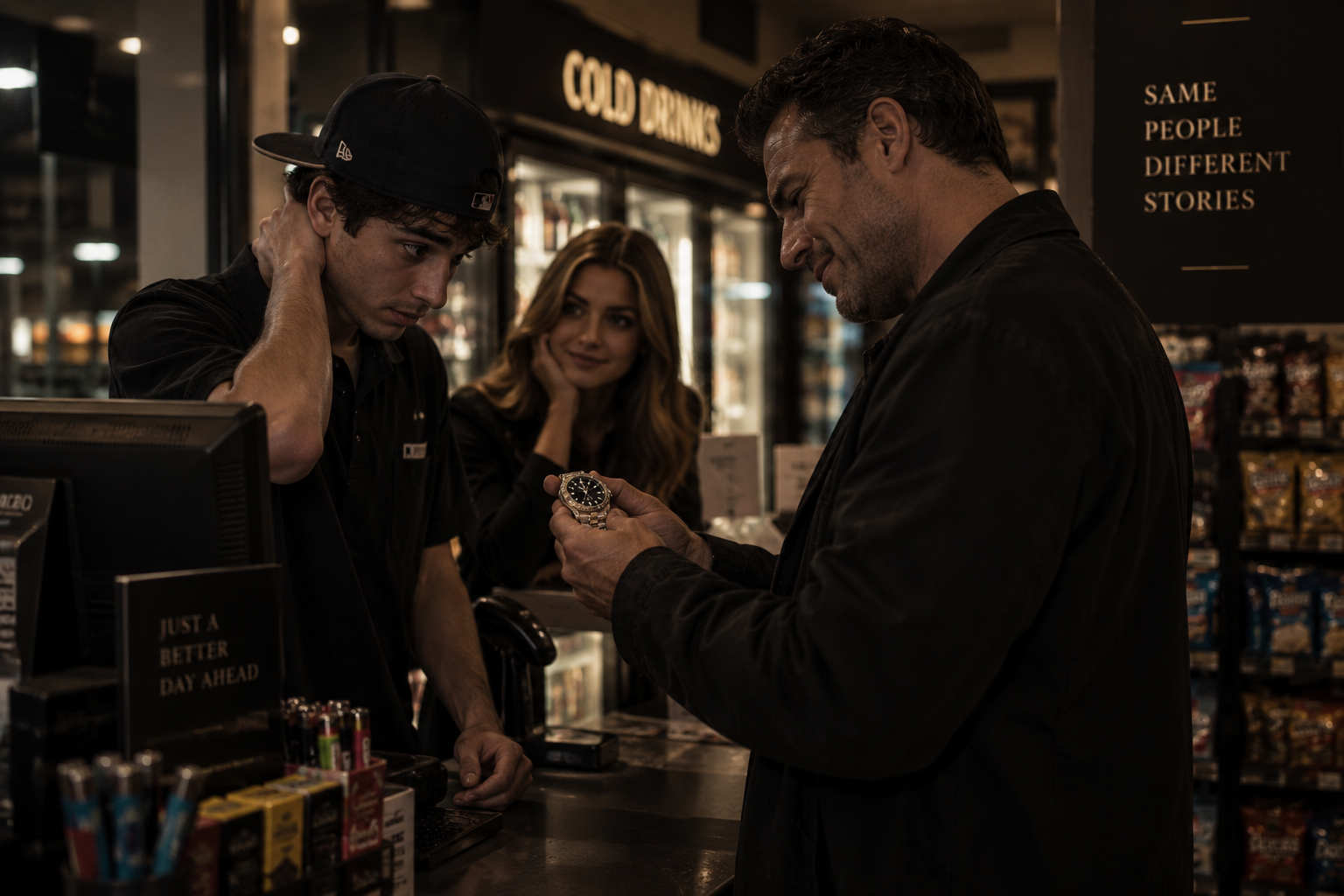
Back in 2005, I worked at a convenience store.
I also had a girlfriend whose family had serious money.
Her father was a very successful attorney. They lived in this enormous house that was probably worth around five million dollars, which in 2005 seemed like an unbelievable amount of money. They had expensive cars, a beautiful home, all of it.
And then there was me.
Working behind the register at a convenience store.
My girlfriend never made me feel bad about it. She actually came to the store all the time just to hang out with me while I worked.
But apparently, somewhere inside my young male brain, I had decided that because her family had money, I needed to look like I had money too.
One day I found a website selling fake Rolexes.
Not just fake Rolexes.
According to the website, these were apparently such incredible replicas that "nobody could tell the difference."
I believed them. The watch was $300.
Now, $300 wasn't exactly pocket change for someone working at a convenience store, but I convinced myself this was an investment in looking successful.
I ordered it.
When that thing arrived, you would've thought Rolex had personally delivered it from Switzerland.
I wore it everywhere. And I didn't wear it quietly either.
I wore that watch with the confidence of a man who had just walked into a jewelry store, written a check for $25,000 and told the salesman to keep the change.
I would casually rest my wrist on things.
The counter.
The steering wheel.
Anywhere the light might catch it.
Nobody had asked about my watch. That didn't matter. I knew it was there.
Then one day my girlfriend was hanging out with me behind the register.
A regular customer came in. He knew me pretty well. We're talking, and suddenly he notices my wrist.
"Nice watch, dude."
Finally.
The moment I'd been waiting for.
I looked down at it like I'd almost forgotten I was wearing a Rolex.
"Thanks."
Then he said something I wasn't prepared for.
"Let me see it."
No problem.
Remember, the website had specifically told me nobody could tell it was fake.
And obviously, websites selling counterfeit watches were known for their honesty.
I took it off and proudly handed it to him. He looked at it. Turned it over. Looked at it again.
Then he looked directly at me. There was a pause.
"REALLY, DUDE?"
My heart dropped.
He knew.
Immediately.
This indestructible $300 masterpiece of Swiss deception had survived approximately four seconds of inspection.
And my rich girlfriend was standing a few feet away.
Luckily, she was distracted.
I looked at him and began communicating in a form of sign language that does not exist in any recognized language on Earth.
My eyes were saying:
"PLEASE."
My head was saying:
"DO NOT DO THIS TO ME."
My hands were probably saying:
"I WILL GIVE YOU FREE SNACKS FOR THE REST OF YOUR LIFE."
He looked at me.
Then he looked toward my girlfriend.
He understood.
A little smile appeared on his face.
He handed the watch back.
"Nice watch."
And walked away.
I wanted to crawl underneath the register.
That night, I was lying in bed thinking about what happened, and eventually I started laughing.
I had spent $300 trying to convince people I had enough money to spend thousands. And the funniest part was that my girlfriend had never asked me to do that.
She already knew where I worked.
She knew I wasn't rich.
She came and sat at a convenience store just because she wanted to spend time with me.
I was the only person I was trying to impress.
That stupid watch actually taught me something.
I decided that night that I never wanted to pretend to have something I hadn't earned.
If one day I wanted the real watch, I'd work for it. If I couldn't afford it, I wouldn't wear it.
I'd rather have something inexpensive that was mine than something expensive that required me to pretend.
I don't know what happened to that fake Rolex.
But more than twenty years later, I still remember the exact look on that guy's face when he turned it over.
No jeweler.
No magnifying glass.
No sophisticated authentication.
Just four seconds.
A look directly into my eyes.
And two words that destroyed my entire career as a fake millionaire:
"Really, dude?"
We Will Figure It Out
I spent most of my working life in sales.
And I hated it.
The strange part was that I was good at it. Really good at it.
I knew how to talk to people, build relationships, handle objections and close deals. There were months when I was the top salesperson in the company. My name would be at the top of the board, I'd get congratulated, maybe get an email recognizing me, and for about five minutes I'd feel proud.
Then Monday would come.
Another sales meeting. Another conference call. Another manager asking what I sold yesterday, what I had in the pipeline, what I planned on closing this week and why something hadn't closed already.
I fucking hated those calls.
I'd sit there smiling and giving all the right answers.
"Absolutely."
"I'm on it."
"Should close this week."
"Yes, I'll follow up."
Meanwhile, deep inside, I wanted to push everyone off a ten-story building.
Not literally, obviously.
But anyone who has spent enough years sitting through sales meetings probably understands the feeling.
The managers weren't necessarily bad people. Most of them were just doing their jobs. The problem was that I had never been built for that kind of life.
I've always been someone who wants to do things his own way. I don't like answering to people. I don't like somebody asking me what I did today or telling me what number I need to hit tomorrow.
Yet somehow I had built an entire career around doing exactly that.
Why?
Because the paycheck kept showing up.
That paycheck was dangerous.
It didn't make me happy. It made me comfortable enough to tolerate being unhappy.
And comfort can be a strange prison because the door isn't locked. You're just scared of what might happen if you walk through it.
For years, I'd think about starting something of my own. I'd get excited about an idea, imagine what it would feel like to build something for myself, and then almost immediately start talking myself out of it.
What if it doesn't work?
What if I don't make enough money?
What if I leave my job and regret it?
What if I lose everything?
So I'd convince myself that staying was the responsible thing to do.
Then I'd wake up, put on the same fake smile, join another sales call and repeat the whole thing.
Eventually, I met the person who changed that.
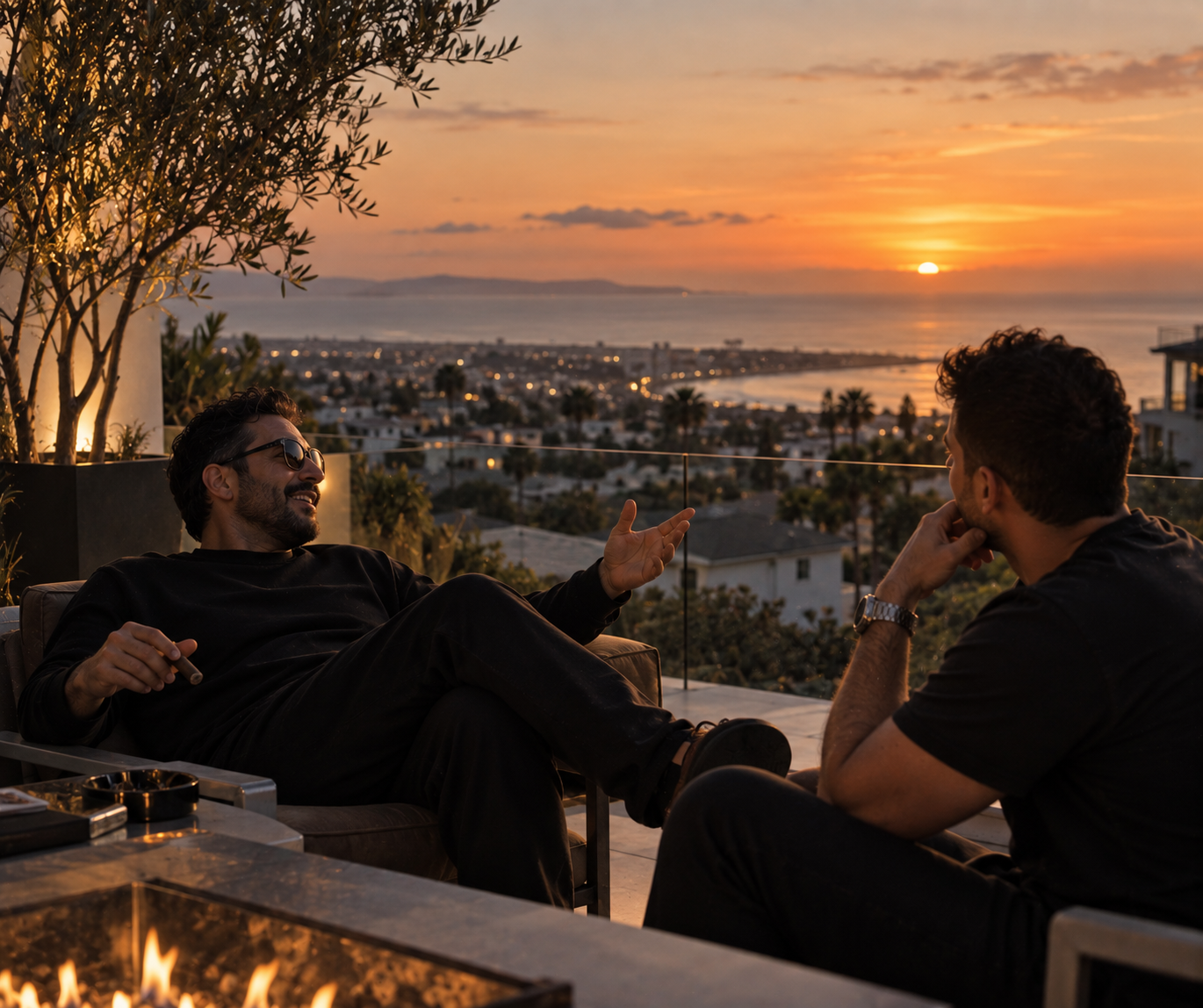
He was an immigrant from Iran with a heavy Persian accent and an attitude toward problems that was almost completely opposite to mine.
His story wasn't some overnight-success bullshit.
He had started his business when he was around twenty years old.
And nothing about his beginning was glamorous.
At one point he was so broke that he lived out of his car for about a month.
When he told me that, I remember thinking about what I would've done in his position.
I probably would have panicked.
He didn't.
He just kept going.
That was the thing about him. The guy was fucking unstoppable.
A problem could happen that would have me thinking about the seventeen different ways everything could go wrong, and he'd barely react.
He had one answer for almost everything.
With that heavy Persian accent, he'd look at me and say:
"WE WILL FIGURE IT OUT."
That was it.
Not a thirty-minute motivational speech.
Not a business seminar.
Not some quote he had read online.
"We will figure it out."
And somehow, he always seemed to.
A year after sleeping in his car, his life looked completely different. He had his own house. Cars. Watches. His business was doing well.
But what impressed me more than the things he owned was the way he moved through life.
He wasn't fearless.
I eventually understood that.
He simply didn't require an answer before taking the first step.
That was completely foreign to me.
I wanted guarantees.
He wanted movement.
We became good friends, and eventually I asked him what exactly he did for work.
He explained his business to me and then casually said something that would end up changing my life.
"I can teach you."
You'd think I jumped at the opportunity.
Of course I didn't.
I immediately became the same scared version of myself I'd been for years.
"I don't know, man. I have a job. I need to make sure I'm making money."
He looked at me like he'd heard this excuse a thousand times.
"Don't worry. Go for it."
Then came the words I would hear from him over and over again.
"We will figure it out."
Eventually, I believed him enough to try.
He gave me his business blueprint.
And I mean that literally. He showed me what he did. He explained what worked, what didn't, how he found business, how things operated, where mistakes were usually made.
There was no jealousy. No hiding information because he was afraid I might become competition.
He opened the book and handed it to me.
I took what he taught me and applied it directly to my own business.
And something happened that I had spent years being too afraid to seriously imagine.
It worked.
Not perfectly.
There were problems.
There were days when something went wrong and I'd call him already halfway into panic mode.
"This happened."
"We will figure it out."
"What if this client doesn't pay?"
"We will figure it out."
"What if I made the wrong decision?"
"We will figure it out."
"What if—"
"We will figure it out."
Sometimes it used to piss me off.
I'd be looking for a detailed answer and this guy would give me the same five words.
But then we'd figure it out.
Every fucking time.
Maybe not the way we'd originally planned. Sometimes the solution cost money. Sometimes it required working harder. Sometimes we had to change direction completely.
But there was always another move.
That's what he was really teaching me.
Problems weren't the end of the road.
They were just the next thing that needed to be handled.
My business kept growing.
Eventually, I started doing better than the guy who had taught me how to do it.
Think about that.
For years, I was afraid I couldn't survive without a paycheck.
Then someone gave me a chance to bet on myself, and I discovered I had been underestimating myself the entire time.
But apparently I still hadn't completely learned the lesson.
Even after the business started doing really well, I was living in the same apartment.
My rent was around $3,200.
One day my friend came over and basically told me I'd outgrown it.
"You need a bigger place."
Immediately, my old brain returned.
"I don't know, man. My rent is pretty low here."
He looked around the apartment.
"Bro. Please. Let's go find you a house."
I started thinking about the money.
Of course I did.
What if business slows down?
What if something happens?
What if I take on too much?
He already knew where my brain was going.
"We will figure it out."
About a month later, I was living in a bigger, better house in a nicer part of Orange County.
My rent went from roughly $3,200 to $6,500.
I remember looking at that number and thinking:
What the fuck did I just do?
Then something interesting happened.
I worked harder.
I started thinking bigger.
The responsibility that I had been afraid would crush me actually pushed me.
I saw what I was capable of doing, and once I saw it, I couldn't unsee it.
And guess what?
We figured it out.
Again.
I never went back.
Looking back, I realize my friend gave me something far more valuable than a business blueprint.
He changed my relationship with fear.
Before meeting him, I believed successful people somehow knew everything was going to work before they took a chance.
They don't.
Nobody knows.
That's the secret.
You take the step without knowing exactly where your foot is going to land.
Then you deal with what happens next.
And then the next thing.
And the next.
Eventually you look behind you and realize you've traveled farther than the person who stood still waiting for certainty.
I will always be grateful to that crazy Persian immigrant with the heavy accent who refused to let problems impress him.
He taught me business.
He taught me to take chances.
He taught me to believe in myself.
But the lesson that stayed with me most was five words.
"WE WILL FIGURE IT OUT."
I've carried those words with me ever since.
And the older I get, the more I believe them.
I've had things happen since then that scared the hell out of me. I've lost things. I've made mistakes. I've had plans completely fall apart. I've had moments when I genuinely didn't know what I was going to do next.
And somehow, eventually, I figured something out.
Maybe it wasn't the answer I wanted.
Maybe life didn't return what I lost.
Maybe the next chapter looked completely different from the one I had planned.
But there was a next chapter.
That's what I want someone reading this to understand.
I'm not telling you to quit your job tomorrow. I'm not telling you to double your rent because some guy on the internet did it. Taking chances doesn't mean being reckless. People have children, mortgages, medical bills and responsibilities. There are times when being cautious is exactly the right decision.
But don't let fear disguise itself as logic for the rest of your life.
Don't spend ten years saying, "Maybe next year."
Don't automatically assume you're incapable of something simply because you've never done it before.
Don't wait for the moment when you're no longer scared.
That moment might never come.
Sometimes you have to be scared and move anyway.
You might fail.
You might lose money.
You might make a terrible decision.
You might have to start over.
And sometimes life will hit you with something you couldn't possibly have planned for.
When it does, remember something a Persian immigrant who once slept in his car taught me:
You don't need to have every answer today.
You just need enough courage to deal with today.
Tomorrow?
We'll figure that out tomorrow.
I spent years choosing security because I was terrified of saying, "Oh well, I tried and it didn't work."
Now I understand there was another sentence that should have scared me much more:
"What if I had tried?"
So take the chance when the chance makes sense. Believe in yourself enough to find out what you're capable of. Work your ass off. Get knocked down. Adjust. Learn. Try again.
Choose "OH WELL" over "WHAT IF."
Because life is going to go wrong sometimes no matter how carefully you plan it.
And when it does?
I can still hear my friend saying it in that heavy Persian accent like the answer was the most obvious thing in the world:
"WE WILL FIGURE IT OUT."
And somehow...
we always do.

The Car Wasn't Mine
I met Rachel on Hinge, and before we even went on our first date, I had already created a problem for myself.
I told her I drove a McLaren.
Technically, I had driven a McLaren before. Maybe four times. The problem was that it belonged to my friend Danny.
My actual car was a 2009 Honda Accord with 187,000 miles, a dent in the passenger door and an air conditioner that worked whenever it felt emotionally ready. There was nothing wrong with my Honda. It got me to work every day. But Rachel's pictures made her look like she lived a completely different life from mine. She worked in marketing, traveled constantly, and every photo seemed to be taken somewhere I couldn't afford. Cabo. Paris. Some rooftop in New York. Even her dog looked expensive.
I was 28, making decent money but spending most of it pretending I made better money.
A few days before our date, we were texting about cars. She asked what I drove. I don't know what possessed me.
"McLaren."
I sent it and immediately stared at my phone.
Then I looked out the window at my Honda.
Danny was one of my closest friends, and he'd recently bought a used McLaren 570S. It was his dream car. He treated it better than most people treat their children.
When I called him and explained what I'd done, he went quiet.
"You told a girl you drive my McLaren?"
"I didn't technically say it was mine."
"What exactly did you say?"
"I said I drive a McLaren."
"You drive a Honda."
"I've driven yours."
"Four times."
Eventually, he agreed to let me borrow it for the night, mostly because I think he wanted to see how badly this was going to end. Before handing me the key, he gave me instructions for almost fifteen minutes. Don't valet it. Don't park near anyone. Don't eat in it. Don't let her eat in it. Don't take it somewhere crowded. Don't launch it. Don't touch some setting I'd never heard of.
Friday night, I pulled up outside Rachel's apartment in a bright orange McLaren.
There is no casual way to arrive somewhere in an orange McLaren.
People were looking at me at red lights. A kid took a picture of the car at a gas station. I hadn't even picked her up yet and already regretted everything.
Then Rachel came outside.
She stopped.
"Oh my God."
I tried to act like this was completely normal.
"Hey."
She walked around the car before getting in.
"This is yours?"
There it was. My opportunity. One word could have ended the entire lie.
Instead I said, "Yeah."
Dinner actually went great. That was the worst part. She was funny and completely down-to-earth. Within twenty minutes, I realized I'd invented this entire version of her based on Instagram pictures. She wasn't asking about money or watches or what neighborhood I lived in. She told me about getting drunk at her cousin's wedding and falling asleep in a coat closet.
Meanwhile, I had a borrowed McLaren sitting outside.
After dinner, we decided to get ice cream. When we came back to the parking lot, I noticed something underneath the car.
A puddle.
I froze.
I knew absolutely nothing about McLarens, but I knew enough to understand that mysterious liquid underneath someone else's supercar was not something I wanted to see.
I called Danny.
He answered with, "What's wrong?"
Not hello.
What's wrong.
"Nothing. Probably."
"Why are you calling me?"
"There's some liquid under the car."
There was silence.
"What liquid?"
"I don't know. Liquid-colored liquid."
He started asking questions I couldn't answer. What side of the car? What does it smell like? Is there a warning light? What's the temperature reading?
Rachel was standing beside me listening.
Then she asked, "Who's Danny?"
"My friend."
Danny shouted through the phone, "DO NOT START MY CAR."
Rachel looked at me.
Then she looked at the McLaren.
Then back at me.
"His car?"
I didn't say anything.
Her mouth opened.
"No."
I started laughing because there was nothing else left to do.
"Okay."
She stared at me.
"This isn't your car?"
"No."
She started laughing.
I told her everything. The Honda. The stupid text message. Danny. Borrowing the McLaren because I thought she'd be impressed. She was laughing so hard she eventually had to sit down on the curb.
Then she said something that made the entire situation even worse.
"You know I drive a Corolla, right?"
I thought she was joking.
She wasn't.
Her glamorous travel photos were mostly work trips. Cabo was her sister's bachelorette party. The New York rooftop belonged to a client. Her actual car was a six-year-old silver Toyota Corolla.
I'd borrowed a McLaren to impress a woman who drove a Corolla.
Danny arrived about thirty minutes later looking like he'd aged five years. He barely acknowledged us. He went straight to the car, crouched down and inspected the puddle.
After about a minute, he stood up.
"Condensation."
"What?"
"From the air conditioning."
Nothing was wrong with the car.
Rachel completely lost it.
Danny finally looked at her.
"Hi. I'm Danny."
She shook his hand.
"The actual owner?"
"The actual owner."
I wanted the parking lot to swallow me.
We ended up sitting on the curb eating melted ice cream while Danny inspected his perfectly healthy McLaren for another ten minutes. At some point, Rachel looked at me.
"Can I tell you something?"
"Please don't."
"I would've gone out with you in the Honda."
That hurt more than anything Danny had said all night.
We went out three more times. It never became anything serious, but she never let me forget that first date. Every time we saw an exotic car, she'd point at it and ask, "Whose friend owns that one?"
Years later, I finally bought myself a nice car.
Not a McLaren.
The first time Danny saw it, he walked around it, looked through the window and nodded.
Then he asked:
"You gonna tell girls this one's mine?"
The Car I Never Reposessed
I've been a repo man for almost twelve years. If you ask most people what I do, they'll usually say something like, "That must be a rough job."
They're right. Nobody is ever happy to see me. I don't make the rules. I just enforce them. The bank sends me an address, I find the vehicle, hook it up, and move on to the next one. It's never personal. At least that's what I used to tell myself.
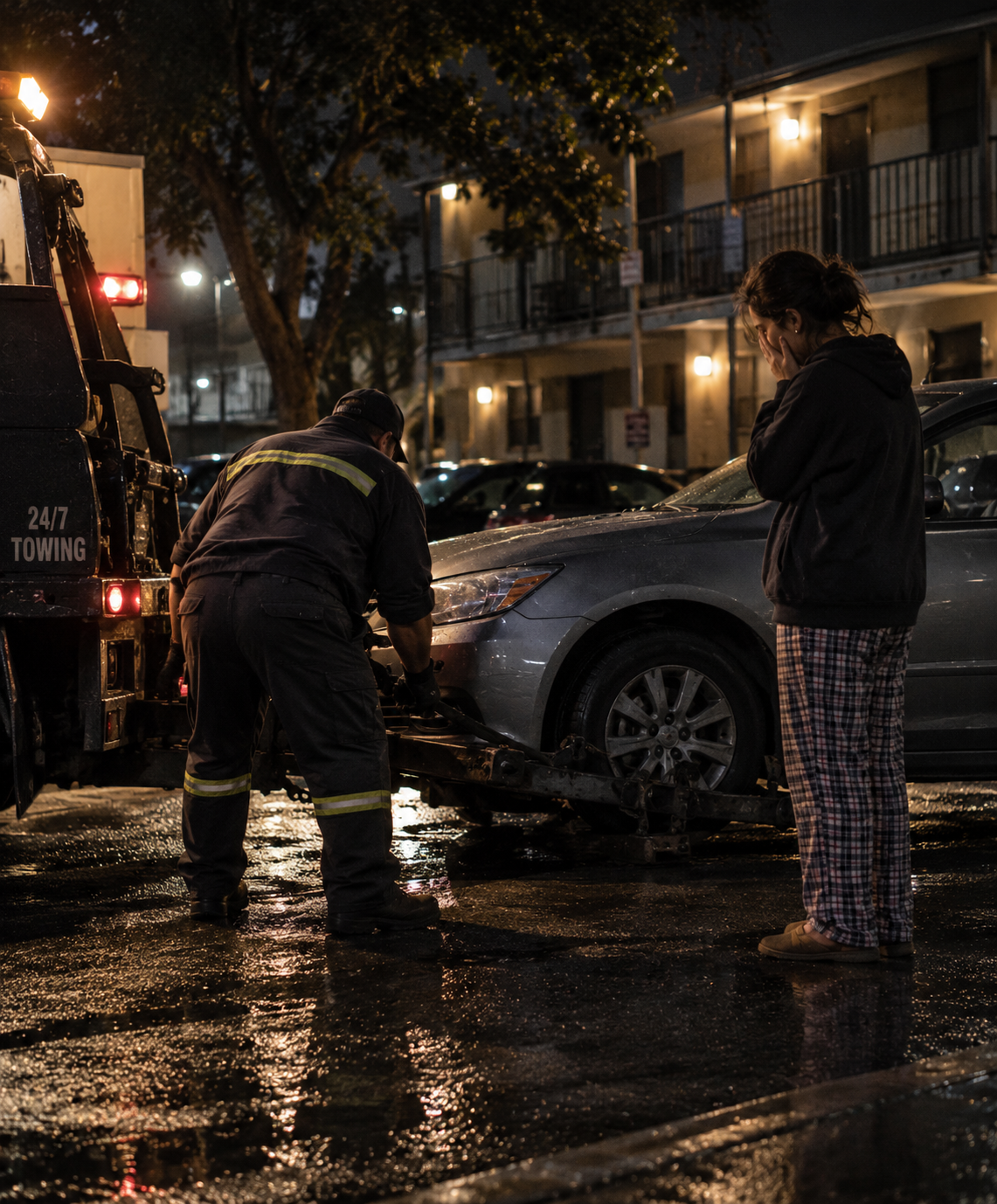
A few months ago, I got an order to repossess a 2016 Nissan Altima. The address led me to a run-down apartment complex on the edge of town. It was the kind of place where every balcony had old patio furniture and every parking space told a different story.
I found the Nissan parked beneath a flickering streetlight. I backed up my truck, hooked the front wheels, and started lifting it. Before the tires were completely off the ground, I heard a door slam.
A woman came running toward me. She was wearing pajama pants, an oversized sweatshirt, and flip-flops. She wasn't yelling or calling me names like most people do. She was crying.
"Please," she said, trying to catch her breath. "I have a job interview tomorrow morning. Eight o'clock. If I don't get this job... we're going to lose our apartment."
She looked back at the car. Then I noticed the child seat strapped into the back. Not just any child seat.
One with a little stuffed elephant buckled into it.
She followed my eyes. "My son," she whispered. "He's asleep upstairs."
I looked down at the paperwork in my hand. The account had been delinquent for months. The bank wasn't doing anything wrong. Neither was I.
If I completed the tow, I'd make four hundred dollars. Four hundred dollars is a lot of money when you're paying bills of your own.
Then I looked back at her.
I've seen people angry.
I've seen people embarrassed.
I've seen people make excuses.
What I saw that night was different. She looked exhausted. Like someone who had spent months trying to stay above water and finally realized she couldn't touch the bottom anymore.
I lowered the Nissan back onto the pavement. Then I climbed out of my truck.
"What happened?" she asked.
I bent down, looked underneath my truck for a second, then shook my head.
"Transmission just locked up."
She stared at me.
"I can't tow anything tonight," I said. "It'll probably take a day to get fixed."
For a second, neither of us spoke. Then she understood. She covered her mouth with both hands.
"You don't have to..." she started. "I know," I said. "Go to your interview tomorrow." She nodded, tears running down her face. As I climbed back into my truck, I rolled the window down one last time.
"And do yourself a favor." She looked up. "Park it around the block tomorrow night."
For the first time since she'd walked outside... She smiled. A small one. But it was there.
The next morning, I called the bank. "I couldn't locate the vehicle," I told them. They logged it in the system and moved on.
I lost four hundred dollars that day. I never found out whether she got the job. I'd like to think she did. Maybe she didn't. Maybe she still lost the apartment.
I'll never know.
What I do know is that, for one night, someone who already had the weight of the world on her shoulders didn't need one more person pushing down. People think my job is about taking cars. It isn't. It's about seeing people on what is often one of the worst days of their lives.
Most days, I have to do my job.
That night... I chose to remember my humanity first. I lost four hundred dollars. But I slept better that night than I had in a long time.
Some debts are written on paper.
Others are measured by the kind of person you choose to be when nobody is watching.
Stories organized by what haunts us
Each category holds a different kind of truth. Browse by the weight that sits heaviest on your heart, or discover stories that mirror your own silence.
Regret
The choices we replay in the dark hours, wondering if we could have chosen differently.
Loss
The people and moments we've lost, and the grief we carry without speaking its name.
Secrets
The truths we've kept locked away, too dangerous or too fragile to share with anyone.
Longing
The desires and dreams we've abandoned, and the lives we imagine in quiet moments.
Your story stays yours, always
Share safely without names, tracking, or judgment. Every confession is encrypted and held in absolute confidence. What you tell us remains between you and the silence.
No names attached to stories
No data collection or tracking
No judgment, only understanding

Stay in the loop
New stories arrive quietly in your inbox each week, unannounced and honest.
FAQ
Questions about how I Never Told Anyone works and what happens to your story.
Yes. We collect no identifying information, no IP addresses, and no metadata. Your story exists without a name attached. Once submitted, it becomes part of the archive, separate from any trace of who wrote it.
Stories are permanent once published. This is intentional—your truth becomes part of the collective archive. If you have concerns about a specific submission, contact us directly and we'll review your request.
We select stories that resonate deeply, that capture something true about the human experience. There's no algorithm, no ranking system. Some stories are featured, others remain in the quiet archive, equally valuable.
We publish stories about regret, loss, secrets, and longing—the full spectrum of what haunts us. We do moderate for safety, but we don't judge the darkness. If your story is honest, it belongs here.
People like you. People carrying their own weight. People searching for proof that they're not alone in what they've never said aloud. This is a space for witnesses and the witnessed.
Your story matters here
Whether you've been carrying this for years or it just surfaced, there's a place for it. Share what you've never told anyone.